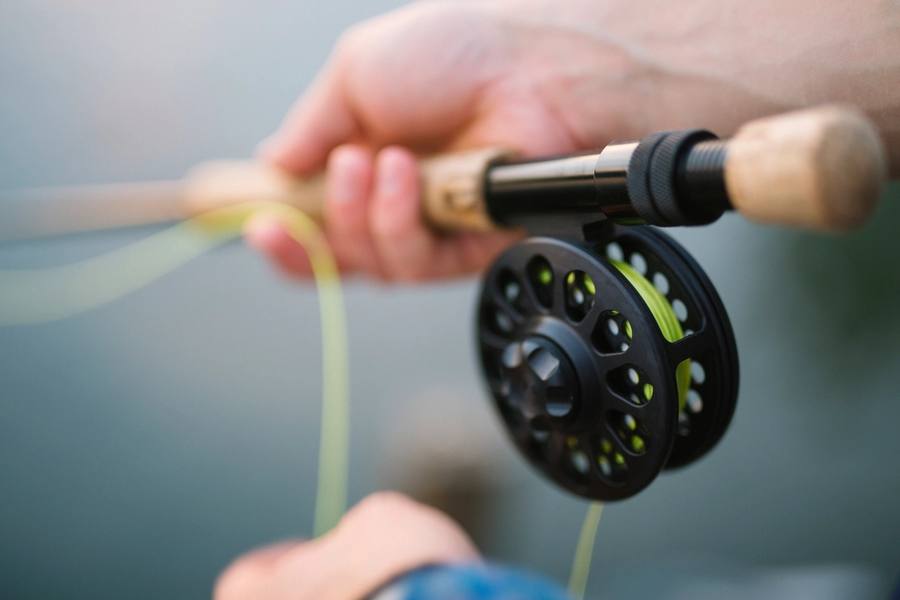
Image illustrative (photo de stock) ; ce n'est pas le produit exact.
Drag Smoothness Is What Matters
A drag lets line out under load so that a running fish does not break the line or pull a hook free, and it must do so smoothly rather than in jerks.
A drag that starts hard and then releases suddenly is what breaks light line, and that initial stickiness is the property that separates good reels from cheap ones.
Bearing counts are advertised heavily and describe smoothness of the handle rather than of the drag, which is a much less important property.
Setting The Drag Correctly
Drag should be set to roughly a quarter to a third of the breaking strain of the line, which is considerably looser than most people set it.
Setting it by pulling line off by hand against a rod held at fishing angle is far more accurate than guessing at the dial.
A drag left fully tightened between sessions compresses the washers permanently, which is a common and avoidable way to ruin a reel.
Gear Ratio And What It Suits
A high gear ratio retrieves line quickly, which suits working lures fast and picking up slack.
A low ratio gives more cranking power, which suits heavy lures, deep water and fighting larger fish without straining the mechanism.
Around five to one is a reasonable general choice, and the numbers matter far less than matching the reel to a rod and line sensibly.
Spool Size, Line Capacity And Balance
Reel sizes are numbered and the numbering is not standardised between manufacturers, which makes stated line capacity a more reliable comparison.
A reel too large for a rod feels unbalanced and tiring, and one too small runs out of line against a strong fish.
A shallow spool filled correctly performs better than a deep spool filled halfway, since line coming off a partly filled spool catches on the lip.
Saltwater, Sand And Maintenance
Salt water destroys reels that are not sealed and not rinsed, and corrosion inside a gearbox is terminal rather than repairable.
Rinsing with fresh water at low pressure after every saltwater session is the single maintenance habit that matters, and hosing hard forces salt into the bearings.
Sand is worse than salt in some ways, since it grinds at every rotation, and a reel dropped on a beach should be cleaned before use rather than after.
Line roller condition is the component most often overlooked and most often responsible for line damage, since a roller that has stopped rotating drags line across a fixed surface at every turn of the handle. That wears a groove which then abrades line continuously, and a fish lost to a sudden break is frequently the result. Spinning the roller with a finger takes a second and tells you immediately whether it is free.
Spare spools loaded with different line let one reel cover several situations, and they cost a fraction of a second reel while achieving most of the same flexibility.
Anti-reverse switches have largely disappeared from better reels, since a solid one-way clutch is more reliable than a switchable mechanism with more to fail.
The Verdict
The workhorse reel for most fishing, where drag quality and basic maintenance determine longevity far more than bearing counts.
Bearing counts are marketing, drags left tight compress permanently, and salt water destroys unrinsed reels.
Slacken the drag off after fishing. Left tight it compresses the washers and ruins the reel permanently.
En un coup d'œil
Avantages
- Smooth front drags protect light line
- Simple, reliable and widely available
- Wide size range for different fishing
- Spare spools allow quick line changes
Inconvénients
- Bearing count marketing is meaningless
- Drags compress if stored tight
- Sizes are not standardised between brands
- Salt and sand destroy unmaintained reels
Questions fréquemment posées
How many bearings do I need?
It is largely marketing. Bearing count describes handle smoothness, not drag quality, and drag is what lands fish. A reel with fewer bearings and a smooth drag beats the reverse every time.
How tight should the drag be?
About a quarter to a third of the line breaking strain, which is looser than most people set it. Pull line off by hand against the rod held at fishing angle rather than guessing at the dial.
How do I look after it?
Slacken the drag off after every session, since storing it tight compresses the washers permanently. Rinse with fresh water at low pressure after saltwater use — hosing hard forces salt into the bearings.
Spécifications
| Type | Front drag spinning reel |
| Critical property | Drag smoothness at startup |
| Ignore | Headline bearing counts |
| Drag setting | A quarter to a third of line breaking strain |
| After fishing | Slacken the drag off |
| Gear ratio | Around 5:1 as a general choice |
| Compare by | Line capacity, not size number |
| Maintenance | Low pressure freshwater rinse |
Résumé
Buy the drag, not the bearing count. And slacken it off between sessions or you flatten the washers.
Vérifier le prix sur Amazon