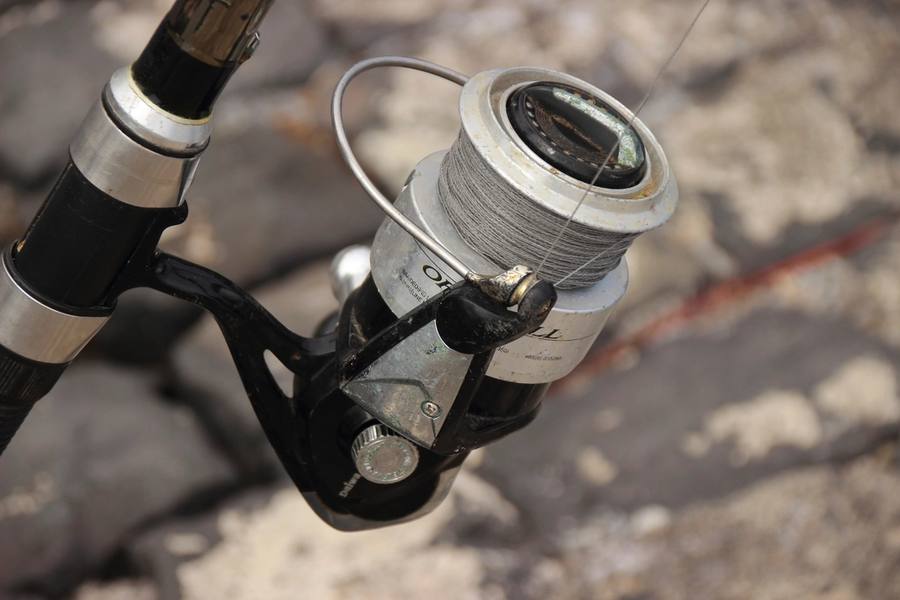
Symbolbild (Stockfoto); nicht das abgebildete Produkt.
No Stretch Changes Everything
Monofilament stretches substantially under load, which absorbs shock and dulls the feel of what a lure is doing.
Braid has almost no stretch, which transmits every bump and tick directly to the hand and sets a hook at distance where mono would simply stretch.
That single property is the reason braid dominates lure fishing, and it is also the source of every disadvantage it has.
No Cushion Means Pulled Hooks
The same absence of stretch means a fish shaking its head at the net has nothing absorbing the movement, which pulls hooks and breaks light hooklinks.
A softer rod and a properly set drag provide the cushion the line does not, which is why braid and a stiff rod is a combination that loses fish.
That is worth understanding rather than treating braid as strictly better, since it shifts where the shock absorption has to come from.
Diameter For Strength
Braid is far thinner than monofilament of the same breaking strain, which means more line on a spool and less water resistance in current.
Thinner line also cuts through weed and cuts fingers, and braid under load will slice skin readily, which is a genuine injury risk when clearing snags.
Never wrapping braid around a bare hand to pull free is the rule, and using a stick or a gloved hand instead is how it should be done.
Visibility And Leaders
Braid is opaque and highly visible in clear water, which matters for wary fish in the way monofilament does not.
A fluorocarbon leader of a metre or two provides near-invisibility at the business end while keeping braid as the main line.
That combination is standard practice and it introduces a knot, which is where the system fails if the knot is tied poorly.
Knots Are Different
Braid is slippery and many knots that hold perfectly in monofilament slip and fail entirely in braid.
Knots designed for braid, with additional turns, are what hold, and using a familiar mono knot out of habit is a common cause of unexplained losses.
Wetting a knot before tightening matters more with braid than with mono, since friction heat weakens the line meaningfully.
Colour choice in braid is worth a thought since high visibility yellow and orange let an angler watch the line for movement at the rod tip, which detects takes that are never felt. That same visibility is what fish see, which is why a leader is standard practice with bright braid. Dark greens and greys compromise between the two and give up some of the line-watching advantage that makes bright braid useful in the first place.
Carrier count describes how many strands are woven together, with higher counts producing a rounder smoother line that casts further and costs more, and four-carrier braid being noticeably rougher through the guides.
Guide wear is a real consideration with braid, since the line is abrasive and older guide materials wear grooves over seasons of use, which then cut the line.
The Verdict
The right main line for most lure fishing, where the lack of stretch must be compensated for elsewhere in the system.
It pulls hooks at the net, cuts hands under load, and requires knots that most anglers do not know.
Never wrap braid around your hand to pull a snag. It cuts skin instantly under load.
Auf einen Blick
Vorteile
- Transmits every detail of what a lure is doing
- Sets hooks at long distance
- Far thinner than mono for the same strength
- Lasts several seasons without degrading
Nachteile
- No cushion, which pulls hooks at the net
- Cuts hands badly under load
- Highly visible in clear water
- Requires braid-specific knots
Häufig gestellte Fragen
Is braid better than mono?
Different. No stretch gives feel and long-distance hooksets, and it also removes all cushion, so hooks pull at the net. A softer rod and correctly set drag provide what the line no longer does.
Why do my knots keep slipping?
Braid is slippery and many knots that hold in monofilament fail in it entirely. Use knots designed for braid, with extra turns, and wet them before tightening — friction heat weakens braid meaningfully.
How do I clear a snag safely?
Never by wrapping the line around your hand. Braid under load cuts skin instantly. Use a stick, a gloved hand or the reel spool with the drag locked and the rod pointed straight at the snag.
Spezifikationen
| Type | Braided main line |
| Key property | Almost no stretch |
| Benefits | Feel, hooksets, thin diameter |
| Cost | No shock absorption at all |
| Compensate with | Softer rod and correct drag |
| Safety | Never wrap it around a bare hand |
| Visibility | Use a fluorocarbon leader |
| Knots | Braid-specific, wetted before tightening |
Fazit
Feel and hooksets at the cost of all cushion. And never wrap it round your hand — it cuts.
Preis auf Amazon prüfen